Mission
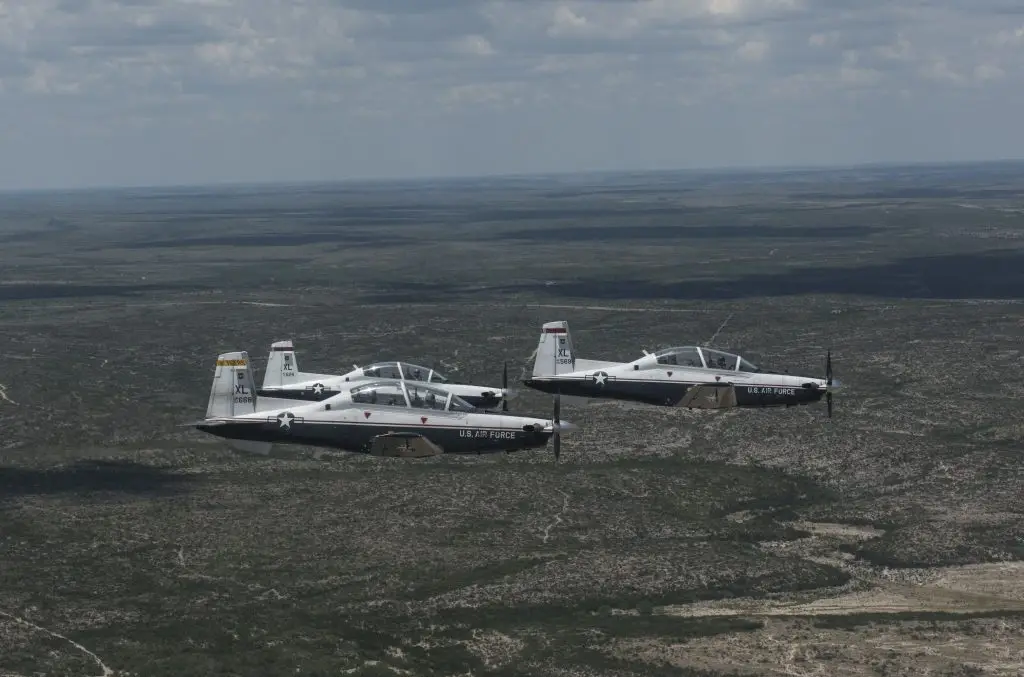
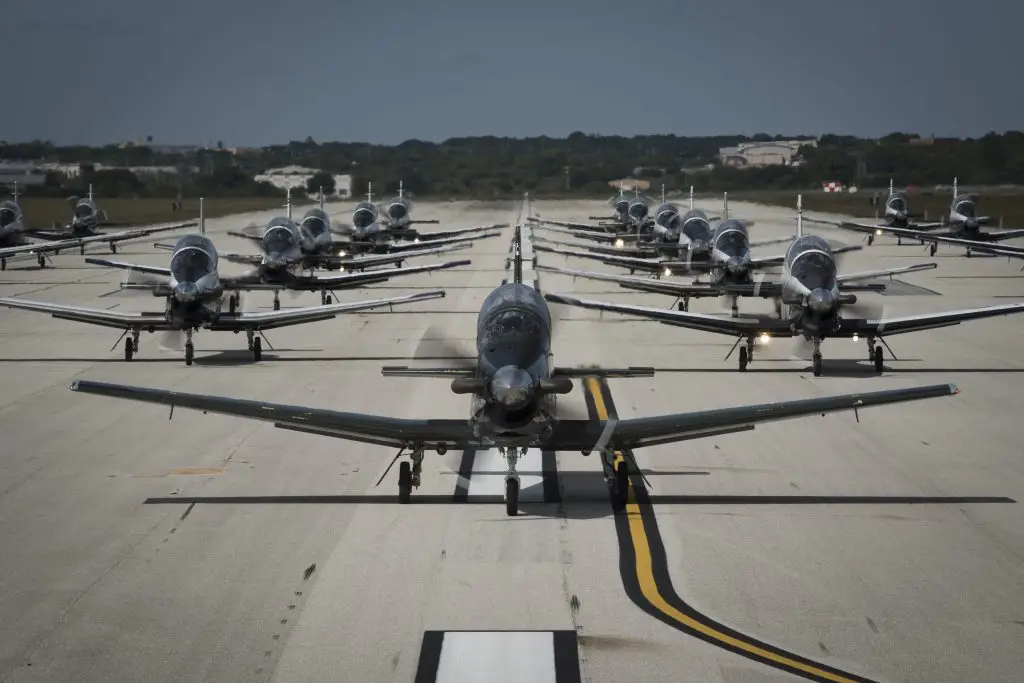
The T-6A Texan II is a single-engine, two-seat primary trainer designed to train Joint Primary Pilot Training, or JPPT, students in basic flying skills common to U.S. Air Force and Navy pilots.
Features
Produced by Raytheon Aircraft, the T-6A Texan II is a military trainer version of Raytheon’s Beech/Pilatus PC-9 Mk II.
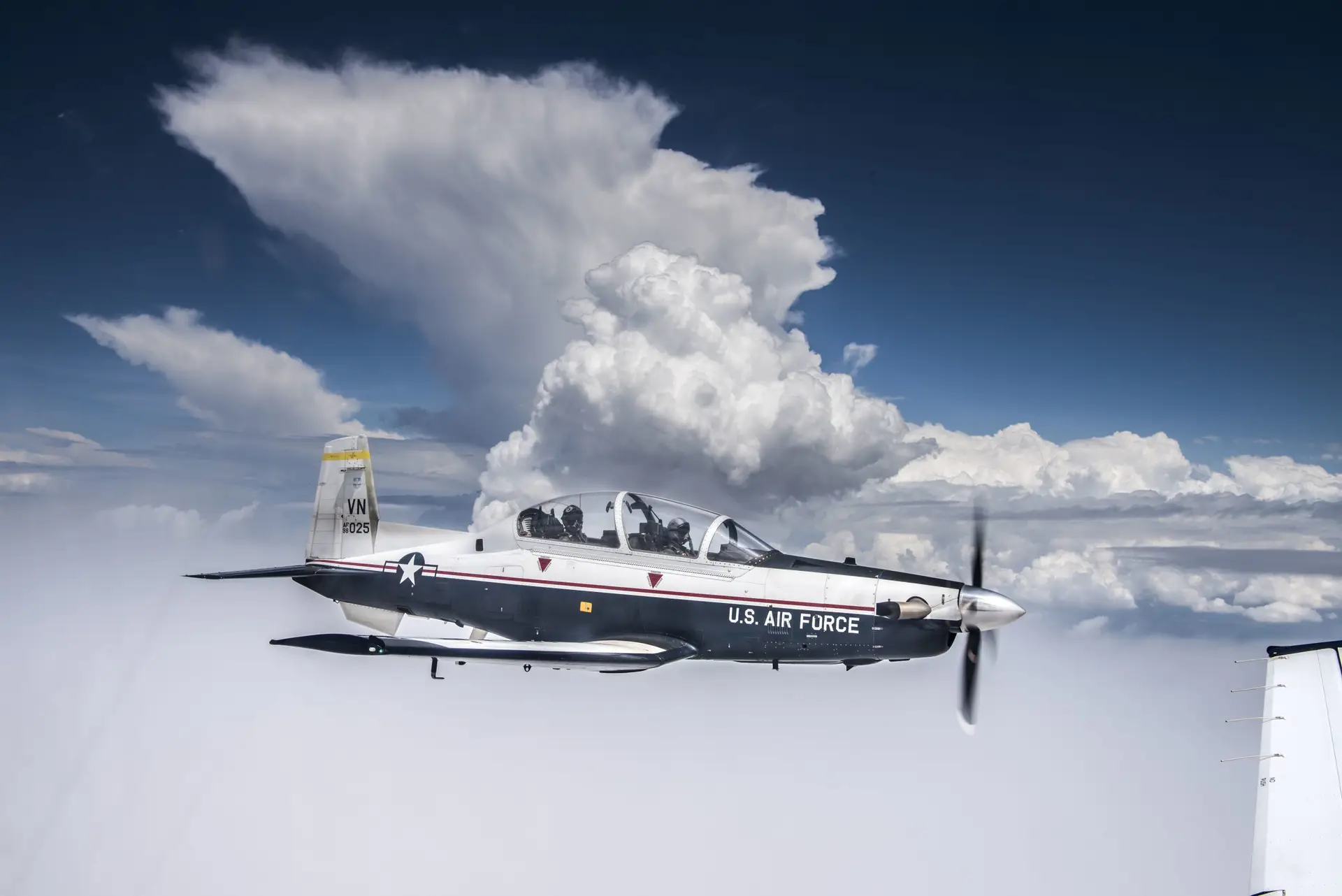
Stepped-tandem seating in the single cockpit places one crewmember in front of the other, with the student and instructor positions being interchangeable. A pilot may also fly the aircraft alone from the front seat. Pilots enter the T-6A cockpit through a side-opening, one-piece canopy that has demonstrated resistance to bird strikes at speeds up to 270 knots.
The T-6A has a Pratt & Whitney Canada PT6A-68 turbo-prop engine that delivers 1,100 horsepower. Because of its excellent thrust-to-weight ratio, the aircraft can perform an initial climb of 3,100 feet (944.8 meters) per minute and can reach 18,000 feet (5,486.4 meters) in less than six minutes.
The aircraft is fully aerobatic and features a pressurized cockpit with an anti-G system, ejection seat and an advanced avionics package with sunlight-readable liquid crystal displays.
Background
Before being formally named in 1997, the T-6A was identified in a 1989 Department of Defense Trainer Aircraft Master Plan as the aircraft portion of the Joint Primary Aircraft Training System, or JPATS. The system includes a suite of simulators, training devices and a training integration management system.
On Feb. 5, 1996, Raytheon was awarded the JPATS acquisition and support contracts. The first operational T-6A arrived at Randolph Air Force Base, Texas, in May 2000. The full rate production contract was awarded in December 2001. Air Force production of the aircraft was completed in 2010.
The T-6A is used to train JPPT students, providing the basic skills necessary to progress to one of four training tracks: the Air Force bomber-fighter or the Navy strike track, the Air Force airlift-tanker or Navy maritime track, the Air Force or Navy turboprop track and the Air Force-Navy helicopter track.
Instructor pilot training in the T-6A began at Randolph AFB in 2000. JPPT began in October 2001 at Moody AFB, Ga., and is currently at Columbus AFB, Miss., Vance AFB, Okla, and Laughlin AFB and Sheppard AFB in Texas.